Termite pressure in Prince George's County is steady because the soil holds moisture. Lots that slope toward the Patuxent River drainage, wooded parcels out along Croom Road near Merkle Wildlife Sanctuary, and homes…
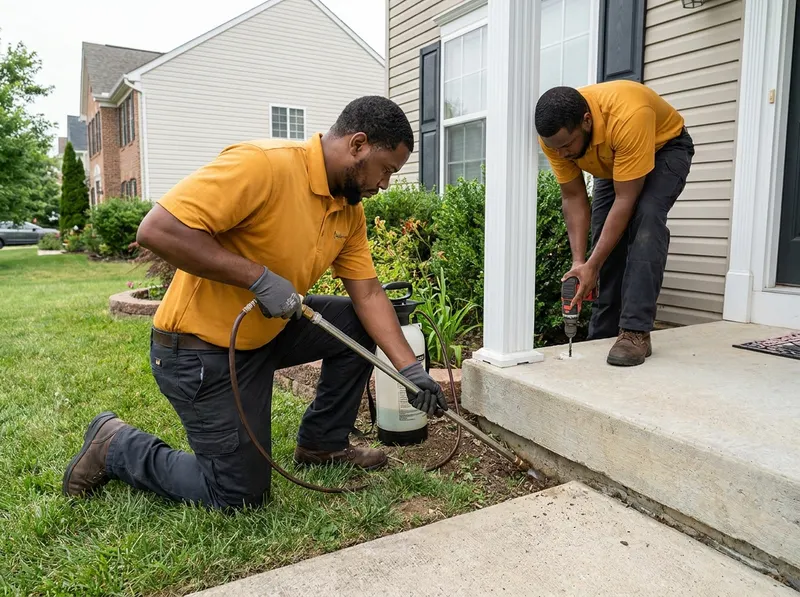
Termite pressure in Prince George's County is steady because the soil holds moisture. Lots that slope toward the Patuxent River drainage, wooded parcels out along Croom Road near Merkle Wildlife Sanctuary, and homes with mulch beds banked against brick veneer all give subterranean colonies exactly what they need: damp soil, a shaded route, and untreated wood within reach. The heaviest call volume arrives from mid-March into May, when winged swarmers emerge — homeowners in Marlboro Meadows and the Old Marlboro Historic District often find them first on a basement window well or a light fixture, not on the wood they're actually eating.
Choosing between a liquid barrier and a bait system comes down to your foundation. A liquid termiticide application means trenching a narrow channel around the exterior, rodding soil under stoops and porches, and drilling through slabs or patio concrete where the trench cannot continue, so the treated zone is unbroken. It works fast on termites already foraging under the house and suits the poured-basement and crawlspace homes common in Perrywood, Balmoral and Oak Creek. In-ground bait stations are installed in the soil every ten feet or so around the structure and are checked on a schedule; baiting eliminates the colony rather than just blocking it, with no drilling through finished flooring or new hardscape. The trade-off is honest: baiting works over months, not days, and depends on the stations being monitored. Newer construction in Beechtree and Marlboro Ridge with wide stamped-concrete patios and irrigation lines is often a better fit for baiting, or for a combination of both.
What we do not do is guess. If the only evidence is a soft spot in a doorframe in Melwood or a single mud tube on a Rosaryville garage wall, the inspection goes further — probing sill plates, checking crawlspace piers, reading moisture at the base of the wall — because the visible damage is almost never the full extent of the tunneling. You will get a diagram showing where activity was found and where it wasn't. If we find carpenter ant frass instead of termite mud, we'll tell you that too, and price the correct job.
Before the visit, clear an 18-inch path along interior basement walls, unlock crawlspace access, and pull stored bins off the floor. Move planters and hoses off the exterior foundation line so the trench can run continuously. Products are applied to label directions at the soil line and inside wall voids, not across living surfaces; re-entry guidance for children and pets is given in writing at the time of service, and for most exterior soil applications the family can stay home. Long term, the fixes that matter most in Upper Marlboro are unglamorous: keep mulch two inches below the siding, fix downspouts that dump against the foundation, and get grade wood — deck posts, fence rails, landscape timbers — off direct soil contact.
Every job gets a firm, written price after a free on-site visit.
Tell us about your subterranean termite treatment job in Upper Marlboro and we'll send a clear, written quote — usually the same day.
 Pestavex Pest Control