Termites in Prince George's County are almost always eastern subterranean termites, and they come up from the soil rather than flying in and landing on your siding. That is why the inspection is built around the ground…
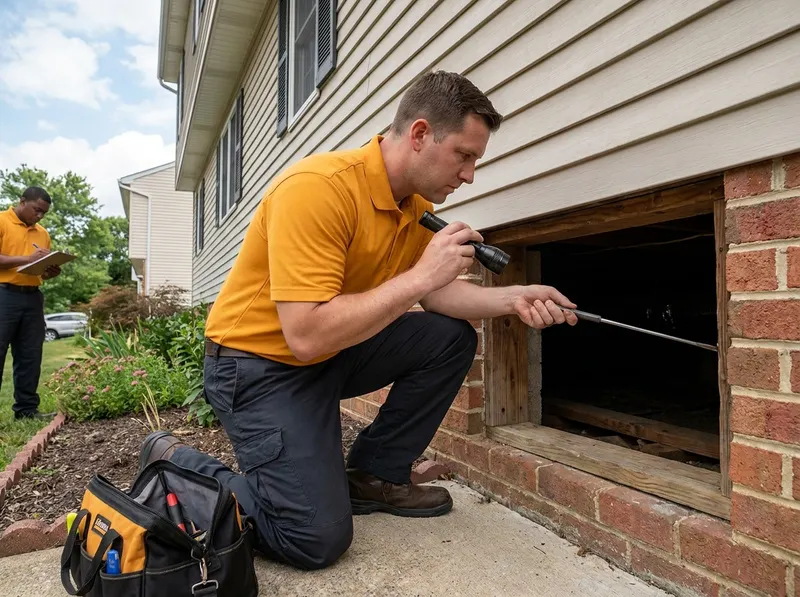
Termites in Prince George's County are almost always eastern subterranean termites, and they come up from the soil rather than flying in and landing on your siding. That is why the inspection is built around the ground line. We look for the pencil-width mud tubes on block and poured foundation walls, mud packed into the joint where the slab meets the framing, blistered or rippled paint on baseboards, and joists that sound hollow under a probe. In spring — usually late March through May here — the first evidence many homeowners see is a swarm of dark winged insects at a basement window well, followed by a scatter of shed wings on the sill. Wings on the floor and no live insects still counts as evidence, and it is worth an inspection.
Housing stock in Upper Marlboro splits the job into two different searches. In the newer developments — Beechtree, Marlboro Ridge, Oak Creek, Perrywood, Balmoral — the common findings are grade and landscaping issues: mulch beds mounded above the brick veneer weep holes, deck ledgers and post footings buried in soil, downspout extensions dumping against the foundation, and stucco or siding carried too close to grade so the soil-to-wood contact is hidden from view. In Marlboro Meadows split-levels and the older homes near Schoolhouse Pond and the Old Marlboro Historic District, we spend more time inside — stone and rubble foundation pockets, wood-framed crawlspaces, and finished basement walls where the only visible clue may be a stain or a tack strip that crumbles. Wooded lots toward Croom, Rosaryville and Melwood add tree stumps, buried construction scrap and firewood stacked against the house, all of which feed a colony close to the structure. Properties on the low ground toward the Patuxent River and Jug Bay hold soil moisture longer, which keeps termite activity active nearer the surface.
An inspection is the right first step when you have evidence but no confirmed identification — a few winged insects, a soft spot in trim, a tube you are not sure is old or active. The alternative is going straight to a full treatment, which makes sense only after activity and its extent are established. The trade-off is honest: an inspection costs less and tells you what you are dealing with, but it does not fix anything, and if we confirm active subterranean termites you will need a treatment on top of it. Some homeowners want the inspection alone for peace of mind before closing on a sale or after a neighbor treated; that is a fine reason to book one, and there is no obligation to buy anything else.
We also tell you what we could not see. Finished basement ceilings, insulated crawlspace walls, wall voids and inaccessible attic sections limit any visual inspection, and pretending otherwise does homeowners no favors. Where access is blocked, we say so in the findings rather than guessing. If activity is found, we walk you through the actual sequence — where the treatment trench or drill line would go, how long the work takes, what has to be moved off the perimeter — and we quote it before anything starts. No annual contract is required to get an inspection, and pricing is explained up front. Call (240) 892-5089 and describe what you found; identifying the pest correctly is the whole point of the visit.
Every job gets a firm, written price after a free on-site visit.
Tell us about your termite inspection job in Upper Marlboro and we'll send a clear, written quote — usually the same day.
 Pestavex Pest Control