Prince George's County gives you four stinging insects worth telling apart, because the treatment differs. Eastern yellow jackets nest underground — old vole tunnels, mulch beds, the loose soil along a fence line — and…
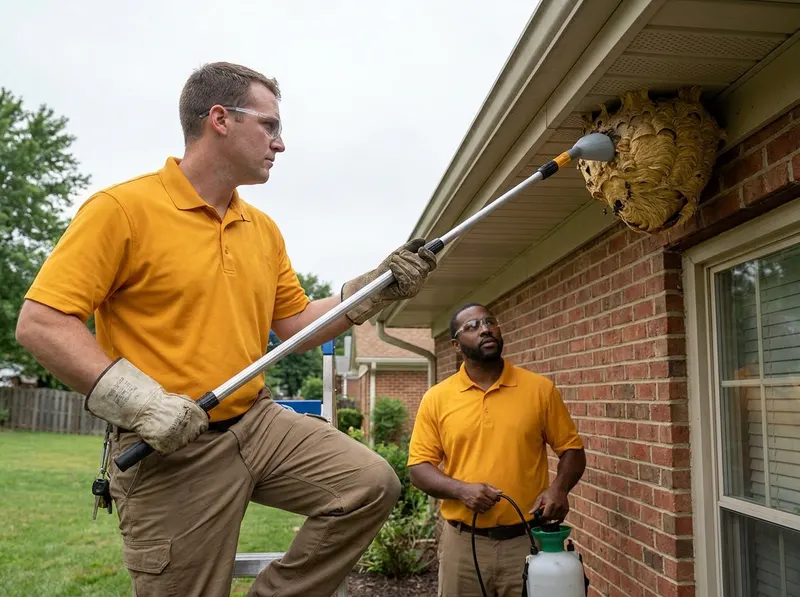
Prince George's County gives you four stinging insects worth telling apart, because the treatment differs. Eastern yellow jackets nest underground — old vole tunnels, mulch beds, the loose soil along a fence line — and the wooded edges in Croom, near Merkle Wildlife Sanctuary, and out toward Patuxent River Park and Jug Bay produce heavy ground-nest years. Bald-faced hornets build the gray football-shaped paper nest, usually 8–20 feet up in a maple or on a gable end. Paper wasps hang a small open comb with visible cells under deck rails, porch ceilings and playset canopies — common on the newer decks in Beechtree, Marlboro Ridge, Oak Creek and Perrywood. European hornets are the large ones that thud against lit windows after dark and nest in hollow trees and wall voids, and they show up around the older brick and clapboard homes near the Old Marlboro Historic District and Schoolhouse Pond.
A one-time nest removal is the right call when you can point at a single problem: a nest by the front door, a ground colony where the kids cross to the swing set, wasps coming out of a soffit corner. It is finished work with a clear end point. A recurring exterior service makes more sense on a home in Marlboro Meadows or Balmoral that produces new paper wasp combs under the same eave every June and July — treating quarterly stops combs before they hold 50 workers. The trade-off is honest: one visit solves today's nest and nothing else, while a recurring plan costs more over a year and prevents the next three.
There is a real safety line with yellow jackets specifically. Colonies peak in August and September, workers get far more defensive as the colony ages, and a disturbed ground nest will send dozens of stingers at a vibration source from ten feet away. Do not spray a ground nest at midday and do not run a mower over the entrance — both produce multiple stings and neither reaches the queen. Store-bought aerosol usually just splits a wall-void colony, pushing wasps deeper and sometimes into a bedroom or bathroom vent instead of out the original hole.
After treatment we come back to the sealing part, because that is where the job actually holds. Accessible aerial nests get physically removed so no one keeps flinching at a dead nest. Wall-void and soffit entries get sealed once activity stops — usually a few days later, never the same hour, since sealing a live colony drives it inward. We do not treat honey bee colonies; a honey bee swarm on a Rosaryville or Melwood property gets referred to a local beekeeper who can remove it alive. Mud daubers, which build the small tube nests on Melwood garages and outbuildings, sting almost never and we will tell you when they can simply be scraped off rather than treated. Every price is given to you before anything is opened or sprayed, and you get plain re-entry guidance for the specific material used before we leave the driveway.
Every job gets a firm, written price after a free on-site visit.
Tell us about your yellow jacket and wasp nest removal job in Upper Marlboro and we'll send a clear, written quote — usually the same day.
 Pestavex Pest Control